
The 3-Second Drop: Why Shoes Pile Up at the Door and What Actually Helps
Why do shoes always seem to end up scattered around the entrance? The answer may have less to do with storage space and more to do with everyday habits. Explore practical ways to make shoe storage easier, create a more organised entryway and reduce the daily clutter without buying more furniture.
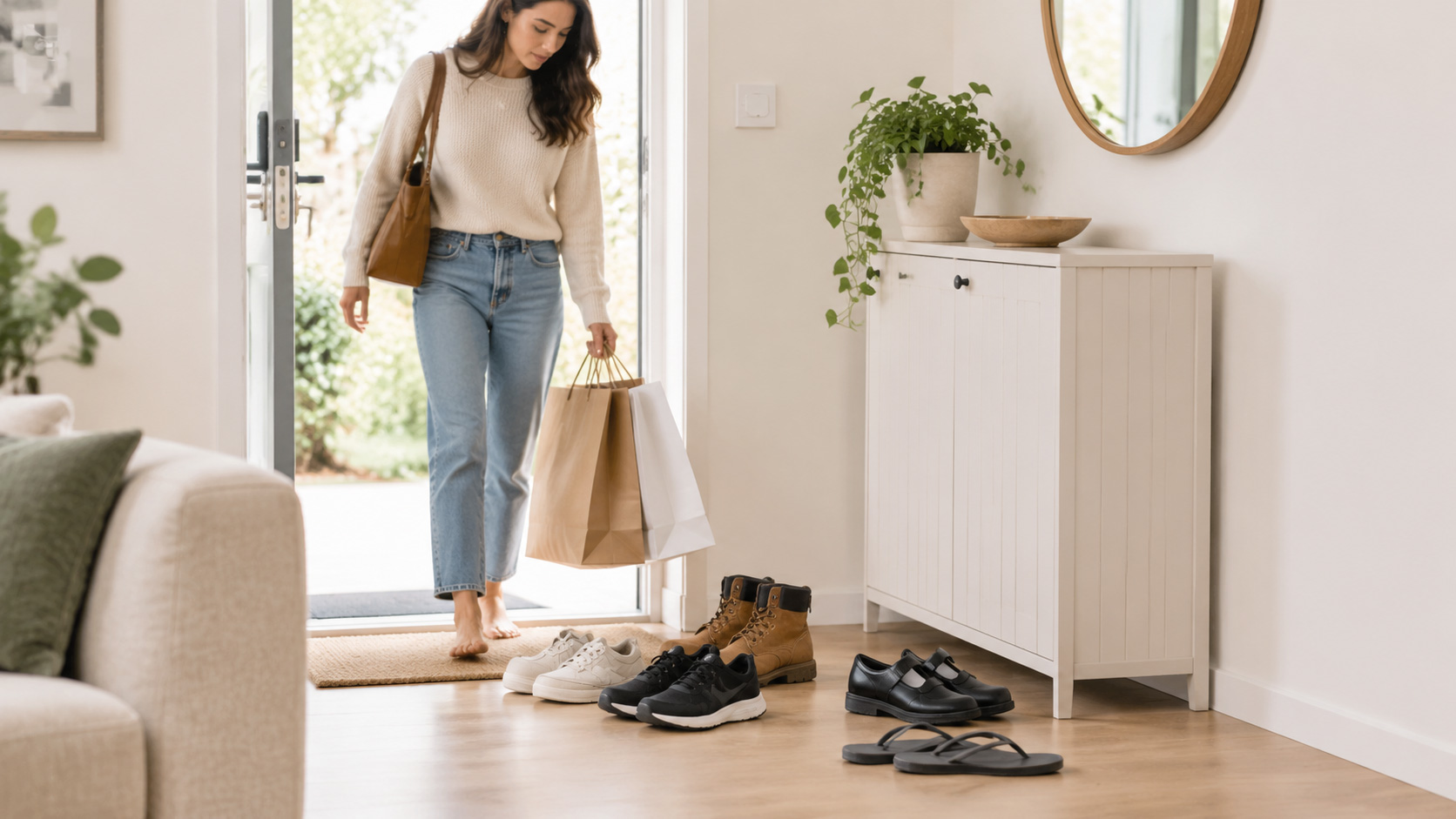
You come home carrying shopping bags, take off your shoes and head inside. The shoes stay exactly where you left them, even though the shoe cupboard is only a few steps away.
By the end of the week, they have company: school shoes, trainers, work boots and a pair of thongs nobody remembers leaving there.
The entrance gradually becomes a collection point for everyday footwear. You clear it on Sunday, but by Tuesday, the same familiar pile has returned.
Call it the three-second drop. It is not a scientific rule, but a familiar household moment: the gap between taking shoes off and putting them away.
It is tempting to blame forgetfulness or assume the household simply needs a bigger shoe cabinet. But the real issue may be more practical. Perhaps the storage is too far away, the compartments are difficult to access, or the shoes people wear most often have nowhere convenient to go.
Before buying more storage or reminding everyone again, look at what happens between arriving home and moving on with the rest of the day. Understanding that small moment can reveal why an otherwise organised entryway keeps becoming cluttered.
Read the Shoe Pile Before You Clear It
The next time shoes collect near the door, pause before putting everything away. Look at what has accumulated and consider whether the same pairs appear repeatedly.
Different patterns can reveal different problems.
The same everyday shoes are always outside: Their usual storage position may be inconvenient, difficult to reach or already occupied.
Bulky boots sit beside the cabinet: The available compartments may not accommodate their height or shape.
Several pairs are neatly lined up: Household members may already be trying to organise their footwear, but the existing storage arrangement may not be practical enough.
Shoes are scattered across the hallway: There may be no obvious shared destination, or people may be removing their footwear at different points around the home.
Wet or muddy shoes remain outside: They may need somewhere to dry before being returned to enclosed storage.
These patterns are clues rather than proof. Ask the people using the space what makes putting their shoes away inconvenient.
It is also worth looking at the footwear itself. In a Houzz Australia interview, stylist and author Wendy Mak recommends sorting shoes by type because different styles have different storage requirements.
A collection of bulky work boots, high-top trainers and everyday sandals will not necessarily fit into the same arrangement equally well.
The important distinction is between a storage problem and a routine problem. If shoes do not fit, moving the cabinet closer will not solve everything. If the storage is perfectly suitable but nobody knows where each pair belongs, buying a larger cabinet is unlikely to help either.
Start by identifying the actual obstacle rather than treating every pair left on the floor as the same problem.
The Real Problem May Be the Journey, Not the Storage Capacity
Imagine two people arriving home after work.
The first takes off their shoes and places them directly into an accessible compartment. There is no rearranging, no searching and no extra trip.
The second needs to put down their bags, walk around another pair of shoes, open a cupboard, move something out of the way and find an available space.
Both have access to shoe storage, but only one can use it without interrupting the natural arrival routine.
This is where small inconveniences matter.
Habit research helps explain why the setting around an action can influence whether it is repeated. Familiar surroundings and preceding activities can become associated with everyday behaviours, making the environment an important part of how routines develop.
Research on behavioural friction also highlights the value of making desired actions easier to complete. This does not mean that a particular shoe rack will automatically change household habits, but it does suggest that reducing unnecessary steps is worth considering.
For an entryway, examine three common sources of friction:
Distance and positioning
If the shoe cabinet is located away from the door people normally use, putting footwear away requires an additional journey. That may seem minor, but it becomes less convenient when someone is carrying shopping, managing children or arriving home in a hurry.
Accessibility
A compartment may technically have enough room, but if it requires moving several other pairs first, it is not particularly useful for everyday footwear.
Unclear organisation
When everyone shares the same cabinet without an agreed arrangement, people may not know where their shoes belong. The easiest option becomes leaving them wherever there is room.
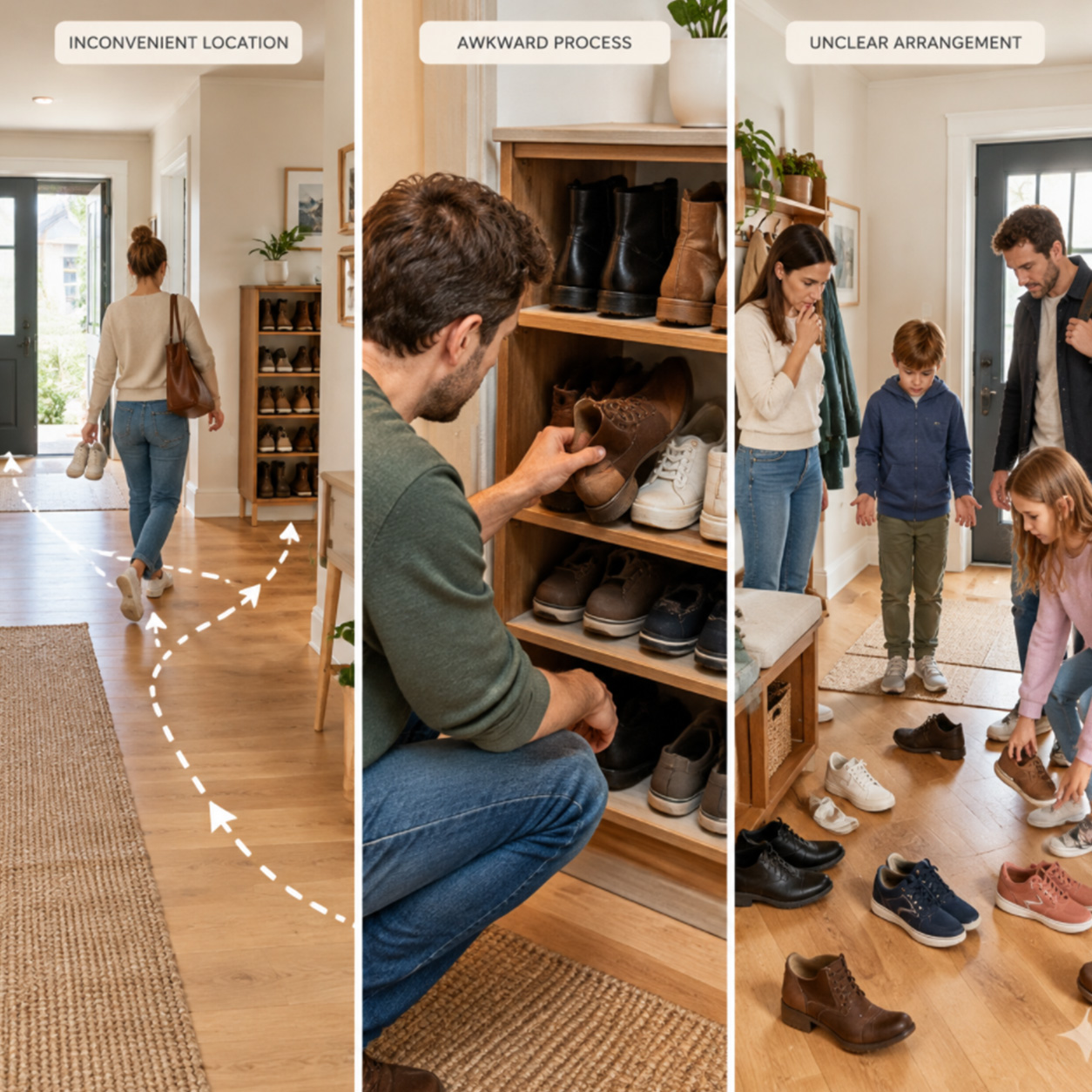
The solution is not necessarily to remove the cabinet door or buy more furniture. Sometimes, simply relocating everyday shoes to an easier-to-reach section or moving occasional footwear elsewhere can remove most of the inconvenience.
The goal is to make putting shoes away feel like the natural next step after taking them off.
Organise Around What People Actually Wear
One common mistake when organising a shoe cabinet is treating every pair as equally important.
A household might own twenty or thirty pairs of shoes, but only a small selection is used regularly. If all of them occupy the most accessible compartments, the footwear people need every day can end up competing for space.
Instead, organise shoes according to how frequently they are used.
Everyday footwear
Work shoes, school shoes, frequently worn trainers and casual sandals should have the easiest access. These are the pairs most likely to be removed and returned every day.
Occasional footwear
Dress shoes, special-event footwear and seasonal styles do not necessarily need to occupy the most convenient positions. They can be stored on higher shelves, in less frequently accessed compartments or elsewhere in the home.
Bulky footwear
Work boots, hiking shoes and high-top trainers often need more vertical and horizontal space. Trying to squeeze them into compartments designed for flat footwear can make the entire arrangement difficult to maintain.
Seasonal footwear
Gumboots and heavier winter shoes may become more important during wetter or colder months, while sandals and thongs are used more frequently in warmer weather. Their storage positions can change as household routines change.
There is no need to impose an identical shoe limit on every person. Someone who changes between work boots, casual shoes and sports footwear has different storage needs from someone who wears the same trainers most days.
A useful starting point is to look at what each person genuinely wears during an ordinary week, then give those pairs a defined space.
Wendy Mak also recommends removing footwear that is no longer wanted or needed before planning storage around what remains. This makes it easier to assess how much usable space the household actually requires.
The key is to organise around real usage rather than the total number of shoes owned.
Make the Most of the Space Inside Your Shoe Cabinet
A shoe cabinet can have plenty of overall capacity and still fail to accommodate the footwear that needs to be stored.
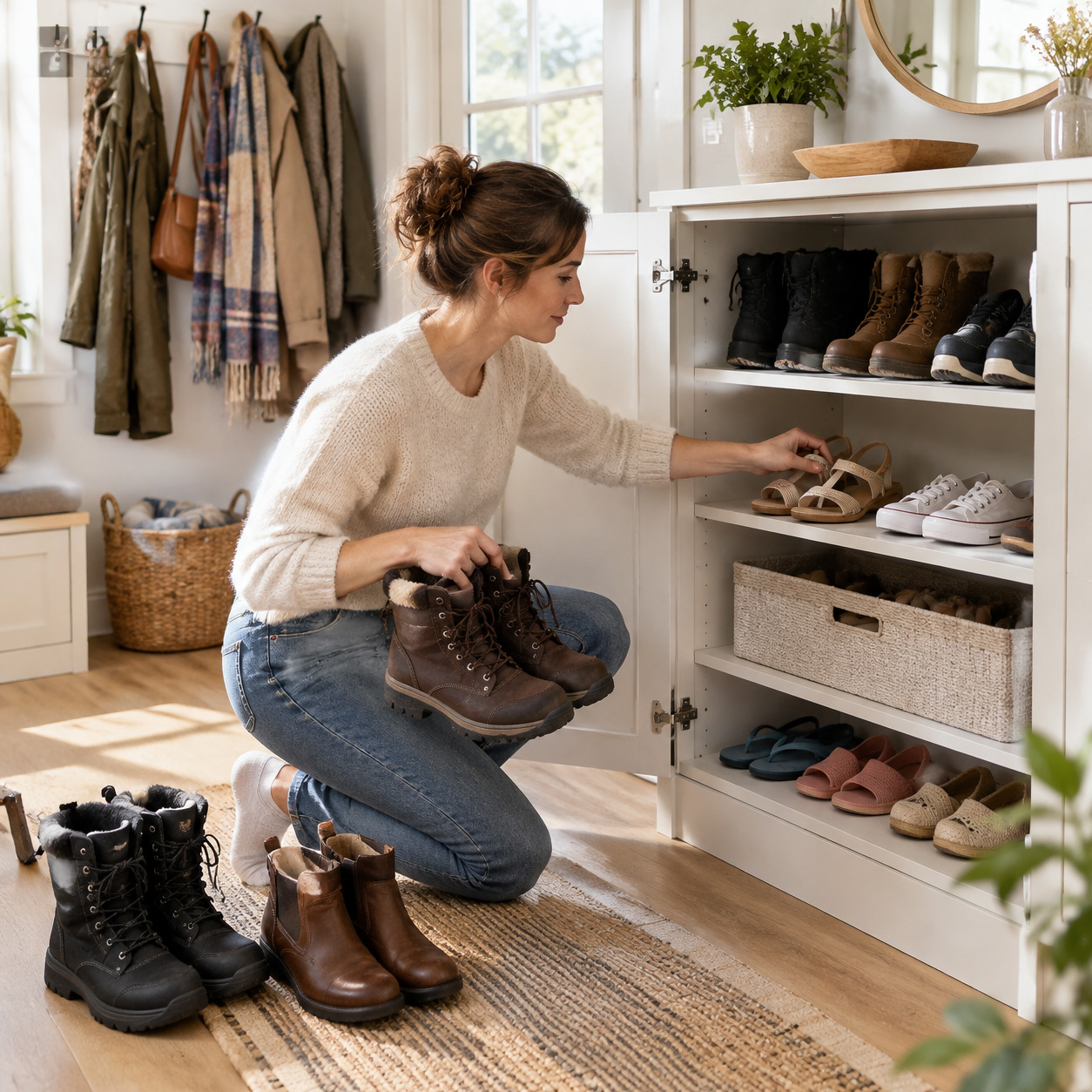
For example, if wet school shoes are left beside the entrance, make checking and returning them part of an existing evening routine. Once they are dry, they go back into their usual compartments.
Follow the footwear manufacturer's care instructions when choosing how to dry different materials. Direct heat or unsuitable drying methods can damage some shoes.
This small separation between drying and storing makes the overall arrangement more practical, particularly in households with children, outdoor workers or frequent rainy-day footwear.
Design the Storage Around Everyone Who Uses It
A shoe cabinet may look organised when one person arranges it, but that does not mean the rest of the household will use it in the same way.
Consider a family sharing one entrance. Parents have work shoes, children have school footwear and everyone has different routines. One person might leave home early, another might return later, and children may need to access their shoes independently.
A storage system that only makes sense to the person who organised it is unlikely to remain consistent.
Start by making the arrangement easy to understand.
Give each person a recognisable space.
This could mean one section per household member or separate compartments for everyday footwear, school shoes and outdoor shoes.
Keep children's footwear accessible.
If a child cannot reach the allocated compartment or close the cabinet door independently, the system is asking them to complete a task that is unnecessarily difficult.
Match storage to the entrance people actually use.
A beautifully organised cabinet near the front door will not help much if family members usually enter through the garage or laundry.
Make shared areas easy to maintain.
Avoid arrangements that require one person to reorganise everyone else's shoes before they can put their own away.
Labels or simple visual markers can help, particularly in households with younger children. However, the layout itself needs to be practical first.
The aim is not to create a perfectly labelled storage system. It is to make the correct place for each pair obvious enough that everyone can use it without needing constant reminders.
Choose the Right Type of Storage for the Entrance
Sometimes, rearranging the existing cabinet is enough. In other homes, the entrance genuinely lacks suitable storage.
The important thing is to choose furniture according to the space, footwear and daily routine rather than capacity alone.
An open shoe rack and a closed shoe cabinet offer different advantages.
Open shoe racks
Open racks make footwear easy to see and access. They can work particularly well for busy households where people frequently change shoes throughout the day.
They are also useful when footwear needs ventilation or when a household wants a simple, accessible arrangement.
However, shoes remain visible and are more exposed to household dust. An open rack can also look cluttered when too many pairs are placed on it.
Closed shoe cabinets
Closed cabinets help create a cleaner-looking entrance by keeping footwear out of sight. They are particularly suitable for homes where visual organisation and dust control are priorities.
Depending on the design, they can also make better use of narrow hallway spaces.
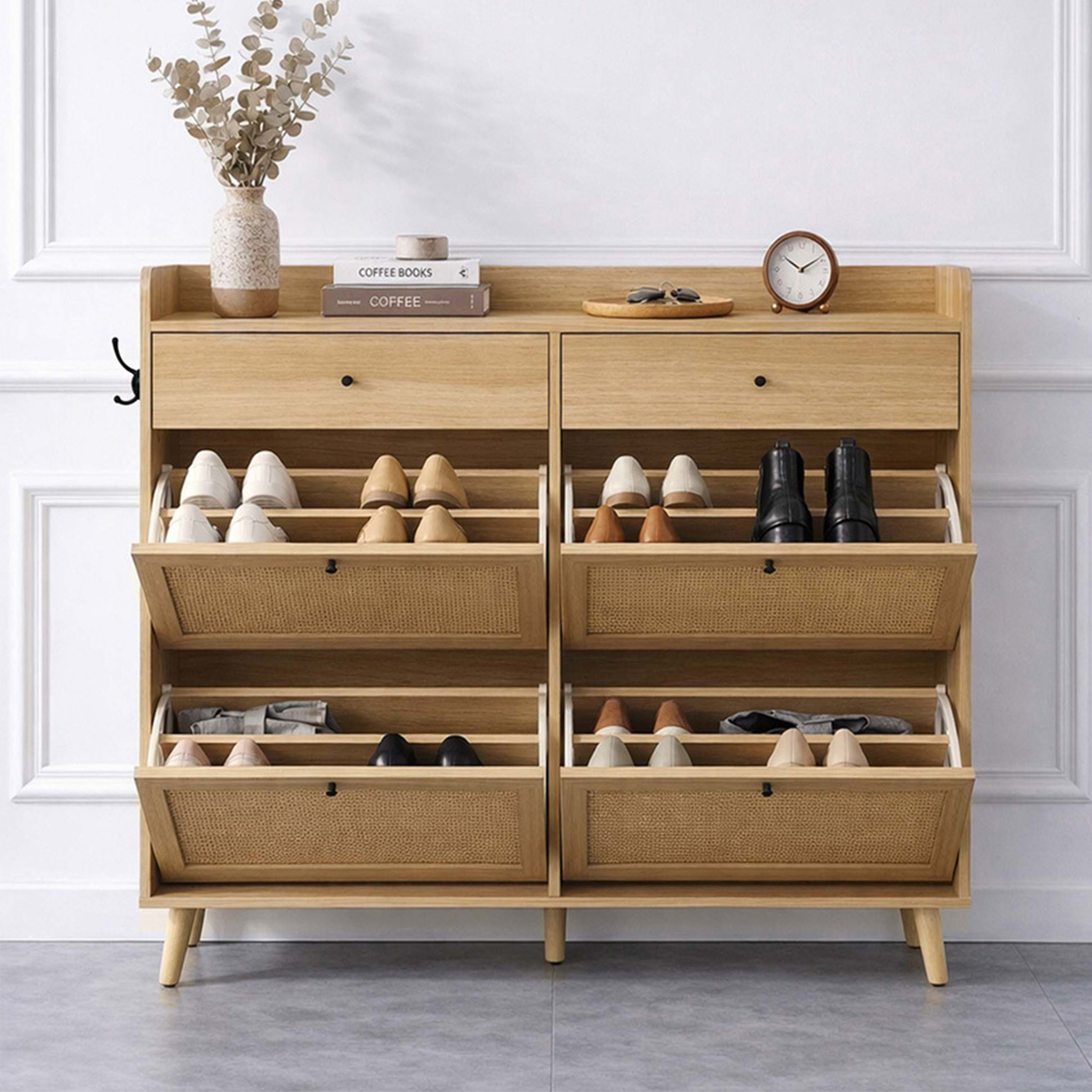
However, internal compartment dimensions matter. A cabinet with unsuitable shelf spacing or insufficient clearance may be frustrating to use, even if its external dimensions seem appropriate.
Slim shoe cabinets
For narrow hallways, a slim cabinet can provide storage without taking up as much floor space as a deeper unit.
Before purchasing, check the actual depth, door-opening clearance and remaining walking space. A cabinet should not make the entrance difficult to navigate.
Combination storage
Some households benefit from combining a small open rack for frequently worn footwear with a larger closed cabinet for occasional pairs.
This separates quick-access storage from longer-term organisation without forcing every pair into the same space.
There is no universally best option. The right design is the one that accommodates the footwear people actually use while fitting comfortably into the available entrance space.
Test One Change Before Redesigning the Entire Entryway
You do not need to reorganise the entire home to find out whether the routine can improve.
Choose the most obvious problem and change one thing at a time.
For example:
Move occasional footwear to a less accessible shelf.
Give everyday shoes a dedicated section near the entrance.
Create a separate drying area for wet shoes.
Reposition the storage where it better matches the route people naturally take.
Adjust shelf spacing to accommodate larger footwear.
Then observe what happens during the next few arrivals.
If you change the cabinet, its location and every household rule simultaneously, it becomes difficult to identify which adjustment actually helped.
A short observation period can be useful. For one week, notice which shoes are still left out, who uses the storage successfully and whether the same problems keep appearing.
This is not a promise that a new habit will form within seven days. Research on habit formation supports repeating an action in a consistent context, but the time needed for a behaviour to become automatic varies considerably.
Try connecting the new action to a familiar moment: once shoes come off, they go into the assigned space before the person moves on.
If the same pairs continue to collect on the floor, do not immediately assume people are ignoring the system. Reconsider whether the allocated space is convenient, accessible and suitable for those shoes.
Only think about buying new furniture once you understand what the existing setup cannot provide. Livarahome offers a variety of shoe cabinet designs to keep your hallway neat and tidy.
A useful arrangement should make the desired action easier, not simply create another household rule to follow.
Measure Success by How the Entrance Works Every Day
A freshly cleared hallway can look successful without working any better.
The real test comes after several days of ordinary household activity.
Instead of judging the arrangement by how empty the floor looks, consider whether it has made everyday life easier.
Look for these signs:
Everyday footwear has a consistent place.
Shoes are easier to find when people need them.
Fewer pairs need to be collected and reorganised by someone else.
Wet footwear has a suitable place to dry.
Children and other household members can use their allocated spaces independently.
The cabinet remains usable without moving several other pairs first.
If these improvements are happening, the storage arrangement is doing its job, even if a few pairs remain visible near the entrance.
On the other hand, if the same problems keep returning, consider whether the current furniture is genuinely suitable.
Perhaps the compartments are too small for work boots, the cabinet is too deep for a narrow hallway, or the household simply needs more accessible everyday storage.
These are specific reasons to consider changing the furniture rather than buying something larger without understanding the problem.
A Better Entryway Starts With a Better Routine
A family entrance is a working space, not a showroom. It needs to accommodate shopping bags, school mornings, wet-weather footwear and the everyday movement of people coming and going.
Some shoes will remain visible. Others may need to dry before they can be stored. That does not mean the entrance is poorly organised.
The more useful goal is to give everyday footwear a clear destination, keep the storage easy to access and reduce the number of unnecessary steps between taking shoes off and putting them away.
Before buying another shoe cabinet, look at the shoes that keep appearing on the floor. They may be telling you more about the limitations of your current arrangement than you realise.
Sometimes, the most effective improvement is not more storage. It is a better position, a more suitable compartment or one less step in the daily routine.